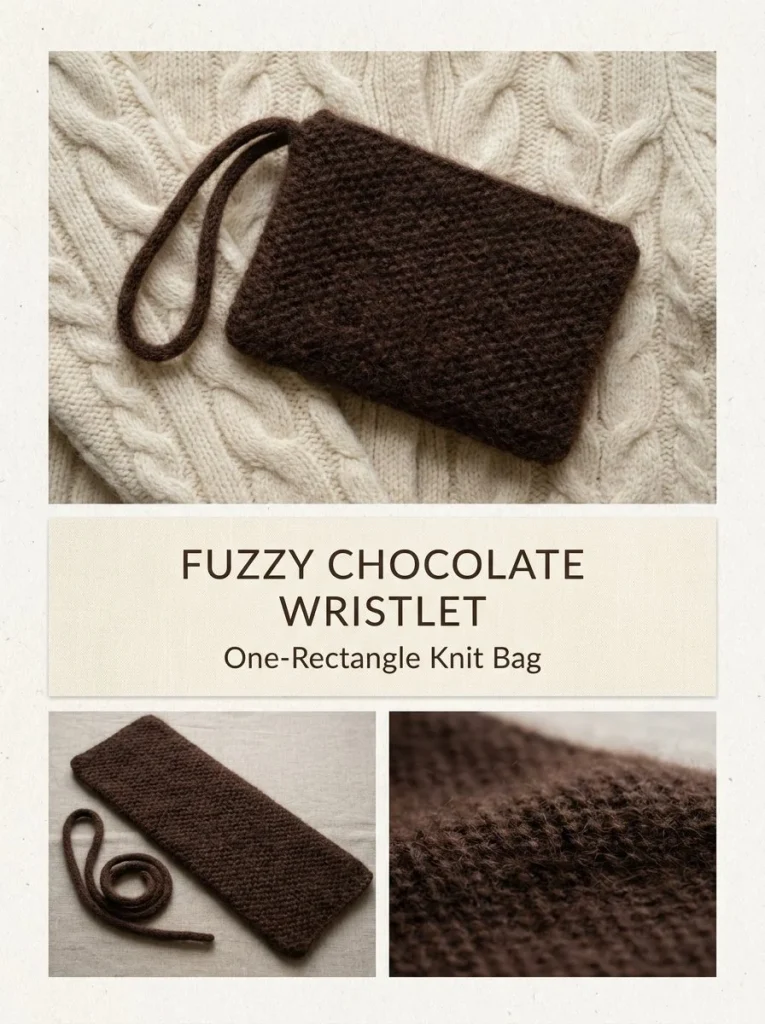
Creating a stylish and cozy wristlet pouch using bulky yarn and simple knit stitches offers both functionality and tactile charm. This accessory features a luscious deep chocolate hue, enhanced with a soft brushed texture that invites warmth and sophistication. Its compact size, roughly 9 inches wide by 6 inches high, makes it perfect for carrying essentials while the thoughtfully designed wrist strap ensures ease of use and security. Crafted primarily with the seed stitch—the classic alternating knit and purl pattern—the pouch displays a subtle textured surface, giving depth without complexity.
The project employs straightforward knitting techniques suitable for those familiar with basic stitches, while the use of bulky #5 yarn transforms it into a luxurious fabric that is both plush and substantial. The construction capitalizes on a simple rectangular main piece folded and seamed to create the pouch body, complemented by an elegant knitted I-cord wrist strap that attaches seamlessly to the top edge. Adding an optional lining or magnetic snap closure elevates the pouch’s utility and finish, making it a practical yet fashionable accessory. For crafters intrigued by restrained designs with tactile appeal, this pouch is a delightful project and an excellent way to practice seed stitch and I-cord knitting.
Notably, if you enjoy creating small bags and pouches, you might also appreciate a berry basket drawstring pouch, which offers a charming twist on functional accessories with drawstring detailing.
Pattern at a Glance
Skill level: Intermediate – suitable for knitters comfortable with knitting and purling, I-cord, and basic seaming techniques
Terminology: Standard American knitting terms (K = knit, P = purl, CO = cast on, BO = bind off)
Construction: Rectangular body knit in seed stitch, folded and mattress-stitched at sides; knitted I-cord strap attached to side seam
Finished size: Approximately 9 inches wide by 6 inches high (23 x 15 cm)
Yarn weight: Bulky (#5)
Needles: US 10 (6 mm) straight or circular needle for main piece; US 10 (6 mm) double-pointed needles (DPNs) or the same needle used for I-cord strap
Main stitch: Seed stitch
Gauge: About 14 stitches and 20 rows = 4 inches / 10 cm in seed stitch
Joining: Mattress stitch along side edges
Optional finishing: Magnetic snap closure, fabric lining
Materials
To create this plush pouch, you will need the following materials:
- Bulky #5 yarn: Approximately 90 to 110 yards (82 to 100 meters) of a soft brushed fiber such as alpaca/wool blend, boucle, or other fuzzy yarn in a rich deep chocolate color. This weight and fiber type contribute to the pouch’s volume and fluffy hand feel.
- US 10 (6 mm) knitting needles: Either straight or circular needles can be used to knit the main rectangular body piece. Circular needles provide flexibility with the working space, though straight needles also work fine given the piece’s moderate width.
- US 10 (6 mm) double-pointed needles (DPNs): For creating the narrow I-cord wrist strap. If preferred, you may use the same straight or circular needles by working the I-cord differently, but DPNs facilitate an easier, round I-cord shape.
- Tapestry needle: For weaving in ends and mattress stitching the pouch sides.
- Scissors: For cutting yarn and trimming ends.
- Optional small sew-on magnetic snap: Adds closure functionality and ease of access.
- Optional light fabric lining: Enhances durability, professionalism, and smooth interior finish.
Yarn and Color Notes
Choosing yarn for a project like this affects both the texture and the functional feel of the pouch. Bulky #5 yarn is ideal for this pattern as it creates a thick, plush fabric that is quick to knit and warm to the touch. The brushed alpaca or wool blend yarn, or a boucle variant, contributes a fuzzy halo that enriches the tactile aesthetic.
Because the stitch pattern is seed stitch—a subtle one-row knit, one-row purl alternating fabric—a fuzzy yarn both softens the stitch definition and enhances its three-dimensional appeal. A deep chocolate color lends a timeless and versatile elegance, allowing the pouch to complement a range of outfits and styles.
This pouch design emphasizes solid, darker hues that showcase the texture without the distraction of variegated or highly variegated yarns. That said, experimenting with complementary neutrals or jewel tones in bulky yarn could personalize the look further for special occasions or seasonal flair.
Finished Measurements
The finished pouch measures approximately 9 inches wide by 6 inches high (23 x 15 cm). This is the size after folding and seaming the main rectangular knitted fabric.
- The width corresponds to the measurement across the open top of the pouch.
- The height is from the fold (bottom) to the top open edge.
This compact size is ideal for carrying small essentials like a phone, wallet, keys, or cosmetics. It fits conveniently on your wrist via the strap without being cumbersome.
Gauge
The gauge for this project is 14 stitches and 20 rows = 4 inches (10 cm) in seed stitch. Measuring gauge accurately is important to achieve the intended finished size and appearance.
- Measure gauge over the seed stitch pattern, blocking your swatch lightly if needed (though gentle blocking is advised for fuzzy yarns to preserve texture).
- If your gauge has more stitches per 4 inches, your pouch will turn out smaller and potentially denser. This can affect how the assembly fits and the strap placement.
- If you have fewer stitches per 4 inches, your pouch will be larger, and the fabric looser, which might not hold its shape as well.
- Adjust needle size accordingly if your gauge differs significantly: smaller needles for tighter fabric, larger needles for looser fabric.
Because this is an accessory, gauge impacts both aesthetics and function, such as strap fit and pouch capacity.
Abbreviations
- CO – Cast on
- BO – Bind off
- K – Knit
- P – Purl
- DPN – Double-pointed needles
Important Pattern Notes
- The texture is seed stitch, achieved by alternating knit and purl stitches every row. The work alternates each row between K1, P1 and P1, K1 to form the classic seed stitch texture.
- The main rectangle is knit flat, then folded and seamed on the side edges to create the pouch shape with the fold acting as the bottom.
- The wrist strap is a knitted I-cord worked in the round using three stitches on DPNs, providing a neat tubular finish.
- Mattress stitch is used for seamless-looking side seaming, preserving the pouch’s neat lines.
- Optionally, a magnetic snap is sewn inside the top opening for closure.
- Optionally, the pouch can be lined with a fabric pouch sewn inside for added structure and protection.
Special Stitches and Techniques
- Seed stitch: Knit 1, purl 1 across one row, then purl 1, knit 1 across the next. This produces a dense, textured fabric that lies flat on knitted pieces without curling.
- Mattress stitch: A nearly invisible seaming method used for joining the side edges of the pouch, creating a flat seam on the right side, perfect for finishing accessories.
- I-cord: A narrow tube knitted in the round, commonly using 3 stitches on DPNs, sliding the stitches to the other end and knitting again repeatedly. It creates a smooth, sturdy strap or decorative cord.
Understanding the Construction
The pouch is constructed simply yet elegantly:
-
Main body: Knit one rectangular panel in seed stitch. The rectangle measures about 12 inches in length and 9 inches wide before assembly.
-
Folding: The rectangle is folded in half widthwise so the cast-on and bind-off edges align to form the bottom of the pouch.
-
Seaming: Mattress stitch closes the two side edges from the fold (bottom) up to the open (top) edge, leaving a little opening to insert items.
-
Wrist strap: Knit separately as a small I-cord loop about 8 inches long, attached securely near the top opening on one side.
-
Optional details: Interior lining and magnetic snap closure can be added according to preference.
The pouch’s straightforward construction makes it a great project to practice seed stitch, seaming, and I-cord knitting.
Complete Pattern Instructions
Main Piece
- Cast on 32 stitches using the long-tail or preferred cast-on method on US 10 (6 mm) needles.
- Row 1: K1, P1 across the entire row. This sets the seed stitch pattern.
- Row 2: P1, K1 across.
- Repeat Rows 1 and 2 until the work measures 12 inches (30.5 cm) from the cast-on edge, ending after completing Row 2.
- Bind off loosely in pattern to maintain stretch and ease for seaming.
Assembly
- Lay the finished rectangle flat with the "prettier" side (seed stitch right side) facing outward.
- Fold it in half widthwise so that cast-on and bind-off edges meet, forming the bottom fold of the pouch.
- Using a tapestry needle and matching yarn, mattress stitch the side edges starting at the fold (bottom) and sew upward to the top edge, leaving the top completely open. This forms the pouch’s body.
- Turn the pouch right side out through the open top edge.
Wrist Strap
- Cast on 3 stitches onto US 10 (6 mm) DPNs.
- Knit 3 stitches. Without turning the work, slide the stitches to the opposite end of the needle and pull the yarn snugly across the back.
- Repeat this stitch slide and knit process until the I-cord measures approximately 8 inches (20 cm).
- Bind off loosely.
- Sew both ends of the I-cord securely into one upper side seam of the pouch about ½ inch (1.3 cm) below the top edge, creating a comfortable wrist loop.
Optional Closure
- Hand-sew a small magnetic snap inside the center top opening of the pouch for secure but easy access.
Optional Lining
- Cut a fabric rectangle slightly smaller than the knitted rectangle.
- Sew into a pouch shape matching the knit piece dimensions, leaving the top open.
- Hand-stitch the fabric lining inside the knit pouch through the top edge to secure.
Finishing
- Weave in all yarn ends carefully with the tapestry needle.
- Gently fluff the brushed surface only with fingertips to avoid damaging the yarn’s fuzzy texture. Do not aggressively brush or comb the yarn as this can cause matting or damage.
Helpful Checkpoints
- After knitting the main piece, your fabric should feel dense, stable, and measure about 12 inches in length.
- Seamed sides must align neatly without puckering, and the opening should remain flexible.
- The wrist strap should fit comfortably around your wrist without being too loose or too tight.
- The final pouch, with or without lining, should measure approximately 9 inches wide by 6 inches high.
Assembly Tips
When mattress stitching, take care to:
- Match the edges evenly to avoid twisting.
- Use mattress stitch’s “invisible” seaming technique for a seamless look.
- Avoid pulling the seam too tight, or the pouch top may pucker.
- Attach the strap securely, reinforcing the seam for durability.
How to Resize
This pattern’s size is controlled primarily by:
- The number of stitches cast on to adjust width (multiples of 2 to maintain seed stitch pattern). For example, casting on more stitches in multiples of 2 will increase width proportionally.
- The length knitted before binding off controls the pouch height; you can knit more or fewer row pairs of the 2-row seed stitch repeat.
- The I-cord length can also be adjusted for wrist comfort or to convert into a longer handle.
When resizing, maintain the seed stitch pattern by keeping stitch counts even and observing the alternating knit-purl sequence each row. Gauge swatching remains crucial to maintain proportions and fabric feel.
Useful Variations
- Different yarn fibers: Use soft merino or a fun mohair blend for enhanced halo and luxury.
- Color accents: Add stripes, color blocks, or a contrasting I-cord for visual interest.
- Lining fabric: Use patterned fabric for a surprising pop inside.
- Closure options: Replace the magnetic snap with a zipper or button loop.
- Longer strap: Extend the I-cord for a crossbody or clutch style.
- For inspiration on small pouches and bags, a blue crochet belt pouch beginner pattern also offers simple stitching techniques for compact handmade accessories.
Troubleshooting
Why Is My Fabric Too Tight or Too Loose?
Check your gauge carefully. If the seed stitch is too tight, try larger needles or softer yarn. Too loose a fabric can cause sagging; reduce needle size or use a firmer yarn.
Why Does My Pouch Edge Curl?
Seed stitch usually lies flat, but very fuzzy yarn or inconsistent tension can cause minor curling. Blocking very gently can help, or adding a lining stabilizes edges.
Why Is My Seaming Visible?
Mattress stitching should be nearly invisible when done correctly. Ensure your yarn matches the fabric color, and weave seams carefully without gaps or puckering.
How Do I Keep the Wrist Strap Sturdy?
Attach strap ends securely into the side seam, reinforcing stitches if needed. Use a strong yarn tail to sew ends, and avoid pulling too tightly to prevent strap distortion.
Can I Skip the Lining or Closure?
Yes, both are optional. Without lining, be gentle with contents as the brushed yarn can snag easily. A snap closure adds security but is not essential.
Frequently Asked Questions
Can I use a different yarn weight?
It’s best to use bulky (#5) yarn for the intended plush fabric and gauge. Using lighter weight yarns will alter the finished size and fabric drape significantly.
Can I use acrylic yarn?
Yes, but fiber choice affects texture. Acrylic may lack the warmth and bloom of brushed alpaca or wool blends, though many soft bulky acrylic yarns are available.
Can a beginner make this?
If you are comfortable knitting and purling and willing to try mattress stitch and I-cord, this project is approachable. Seed stitch is a beginner-friendly textured pattern.
How should I block the finished pouch?
Avoid aggressive blocking because it can flatten the fuzzy yarn. A light, gentle steam or pinning the piece flat while damp to relax stitches is sufficient.
Can I add more pockets inside?
Adding fabric pockets inside the lining is possible before stitching it in. This adds utility but requires basic sewing skills.
Is this pouch reversible?
No, the seaming and strap attachment mean the wrong side is not finished for display.
Optional Related Uses
The seed stitch rectangle and I-cord strap technique can be adapted for:
- Small coin purses
- Wristlet clutches with different color stripes
- Makeup bags
- Lightweight pouches for tech accessories
For ideas on similar projects with variation in closure or strap styles, exploring simple bag patterns such as a drawstring pouch can broaden your accessory skills.
Final Thoughts
This plush, textured wristlet pouch is an elegant accessory that combines simplicity and tactile charm. Its construction boils down to knitting a rectangular seed stitch panel, folding and seaming it neatly, and adding a sturdy knitted I-cord strap. The choice of bulky, fuzzy yarn makes this project appealing and quick, delivering a cozy pouch that is both practical and stylish. Optional finishing touches like lining and a snap closure can customize it for added durability and security. Whether as a gift or a personal treat, mastering this pattern builds useful skills in seeded textures, seaming, and I-cord knitting, and creates a delightful everyday accessory.



