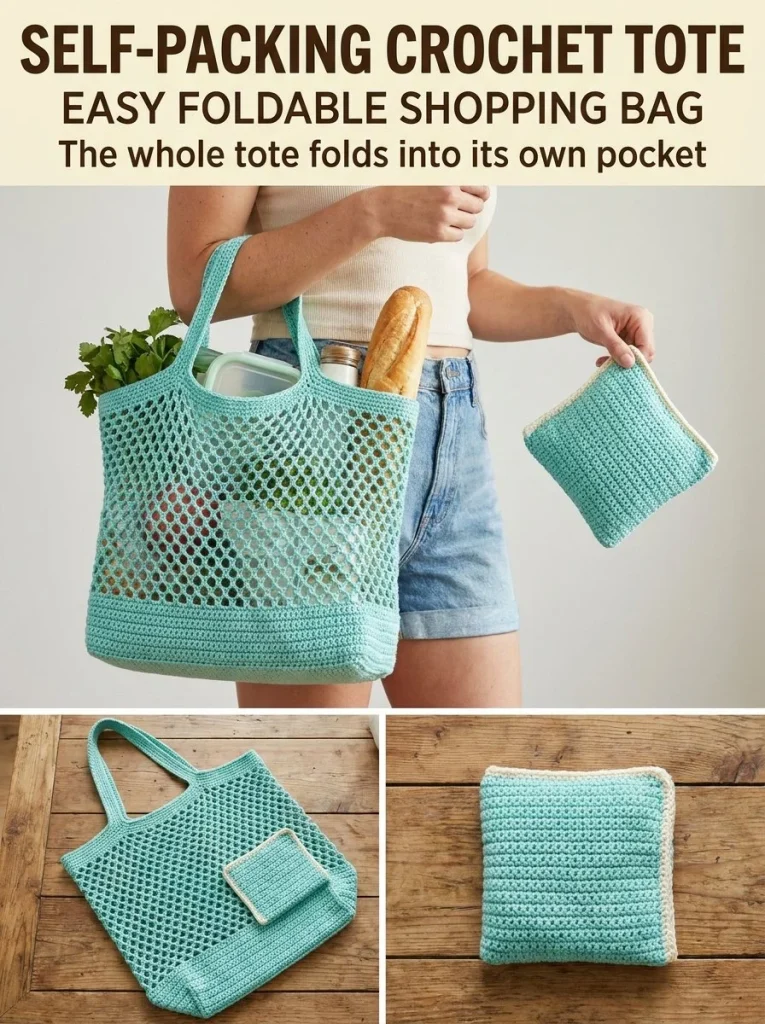
Create a stylish and practical foldable tote bag that fits right into your daily life or shopping routine with this aquamarine cotton crochet tote. Crafted in a pleasant worsted-weight #4 cotton yarn, this bag blends durability and a chic aesthetic. Its open mesh body offers breathability and lightweight flexibility, making it perfect for carrying groceries, beach essentials, or everyday items.
The construction strikes a perfect balance between solid foundational work and airy mesh to keep the bag sturdy yet expandable. Starting with a solid half double crochet base, it transitions into an elegant mesh stitch pattern that provides both functionality and charm. The bag features comfortable handles and a built-in corner pocket cleverly designed to fold the entire tote inside itself for compact, easy carrying and storage. This clever self-packing design is not only a space-saver but also adds an element of convenience that sets this tote apart from typical shopping bags.
For those interested in pairing accessories or adding a bit of flair, consider browsing related projects like the blue bow bag charm to personalize your tote. These small touches can elevate a simple project into a fashionable statement.
Pattern at a Glance
Skill Level: Easy – Suitable for confident beginners and experienced crocheters looking for a quick, useful project.
Terminology: US crochet terms
Construction: Worked bottom-up beginning with a solid base, transitioning into a mesh body, finishing with handles and a sewn-on pocket.
Finished Size: Approximately 12–14 inches tall (body height); width depends on base foundation (approximate due to mesh expansion).
Yarn Weight: Worsted-weight (#4), all cotton
Hook Size: 4.5 mm (G-7)
Main Stitch: Half double crochet (hdc) and mesh formed by chains and single crochet (sc)
Gauge: Not strictly critical but impacts overall size and mesh openness
Motifs: Single square pocket approx. 5 x 5 inches
Layout: Rectangle base, circular mesh body, rectangular pocket attachment
Joining: Seamed pocket; handles worked into body sides
Border: Single crochet edging around base and top
Seaming: Pocket sewn on with side and bottom edges attached only
Materials
- Worsted-weight #4 cotton yarn in aquamarine: The main yarn for the body and pocket. Cotton is durable, washable, and perfect for everyday use.
- Small amount of cream cotton yarn: Used for the decorative single crochet edging on the pocket to enhance contrast and visual interest.
- 4.5 mm (G-7) crochet hook: Best suited for the weight of yarn to create firm but flexible stitches essential for a tote bag.
- Tapestry needle: For sewing the pocket onto the tote securely.
Using cotton yarn provides strength and structure, ideal for carrying items without stretching excessively. The recommended hook size balances stitch definition and fabric flexibility. The tapestry needle facilitates neat and durable finishing.
Yarn and Color Notes
Cotton yarn chosen for its sturdy, natural feel and ease of maintenance. Worsted-weight cotton ensures the bag holds shape but isn’t too stiff. Aquamarine offers a fresh, ocean-like vibe, bright enough to appeal as a fashion accessory.
Cream accent yarn around the pocket offers subtle but elegant contrast, giving the bag a handmade artisanal charm. For those who prefer variations, using variegated cotton yarn or complementary color schemes can create unique personalizations.
Because this project has a mesh body, smooth yarns work best to highlight the stitch pattern and maintain structure; overly fuzzy or loosely spun yarns might make the stitches blend, losing definition and reducing stability.
Finished Measurements
The bag’s body length (height) measures approximately 12 to 14 inches, suitable for carrying everyday items or groceries. The width corresponds approximately to the initial chain of 31 stitches, which will stretch due to the mesh pattern, typically measuring around 14 inches wide when relaxed.
The built-in pocket is a neat 5 x 5 inch square, placed low on the outside of the bag, sized just right to contain the folded bag for self-packing.
These dimensions assume working with recommended gauge and materials; any changes should be expected to affect size correspondingly.
Gauge
While the exact gauge is not critical for this functional tote, a typical gauge with worsted-weight cotton and a 4.5 mm hook in half double crochet is approximately 12 hdc stitches and 8 rows = 4 inches.
If your gauge produces a denser fabric (more stitches per 4"), your bag will be smaller and more compact. Conversely, a looser gauge (fewer stitches per 4") will result in a larger, more open bag structure.
Since the mesh body expands and flexes, a strict gauge match is not essential but checking gauge on the base section ensures your starting rectangle has consistent width and depth.
Abbreviations
- ch: chain
- hdc: half double crochet
- sc: single crochet
- sl st: slip stitch
- st(s): stitch(es)
Important Pattern Notes
- The base is worked in flat rows, turning at the end of each row.
- Mesh body rounds are worked in joined rounds, with slip stitch joins at the beginning of each round.
- Chains in mesh rounds create open spaces for flexibility.
- Handles are incorporated by chaining across gaps and single crocheting around handle edges to maintain shape.
- The pocket is constructed separately and sewn on with bottom and side edges attached; the top is left open to accommodate folding the bag inside.
- The folding method for packing is crucial for the tote’s self-packing feature.
Special Stitches and Techniques
- Half Double Crochet (hdc): Straddles the gap between dc and sc, offering a mesh that is firm but not too stiff.
- Mesh Stitch (ch3 skip 1 st sc in next): Creates a decorative, breathable open fabric, commonly used for market bags.
- Joining Rounds with Slip Stitch: Keeps rounds seamless while transitioning the mesh body.
- Crocheting Handles with Chain Spaces and Single Crochet: Creates stable, comfortable handles that blend naturally into the bag shape.
Understanding the Construction
The tote construction begins with a rectangular solid base worked in rows of half double crochet. This base provides structure and a flat bottom so the bag can stand upright.
Once the base is complete, the project transitions into a cylindrical mesh body created by crocheting around the base edges in rounds. The mesh stitch pattern creates an airy, flexible body that can stretch to accommodate groceries or beach gear.
After reaching the desired height, two rounds of single crochet provide a sturdy top edge. Handles are then crocheted directly onto the top edge with elongated chains spanning about 30 stitches, leaving handles open and comfortable. These are reinforced by single crochets around the chains.
The final piece is a square pocket crocheted separately from aquamarine yarn and edged with cream-colored single crochet on three sides. This pocket is sewn onto the tote’s lower front, leaving the top open to fold the bag into itself, creating a compact, portable carry option.
Full Pattern Instructions
Base
- Start by chaining 31 stitches.
- Row 1: Work a half double crochet (hdc) in the 2nd chain from hook and in each chain across. (You will have 30 hdc stitches across.)
- Rows 2–8: Chain 1, turn your work, and half double crochet across each stitch in the row. Maintain the same stitch count to create a firm rectangular base.
At the end of Row 8, your base should measure approximately 10-12 inches long, forming a sturdy foundation for the bag.
Base Edge
- Work 1 round of single crochet (sc) evenly around the rectangle. To achieve even corners, work 3 sc in each corner stitch, and 1 sc in each side stitch. This round closes the base and forms a foundation for the mesh body to be worked in the round.
Mesh Body
- Begin the mesh body round by slip stitching into the first chain-3 space created after the previous round.
- Now work the mesh stitch around as follows: chain 3, skip 1 stitch, single crochet (sc) into the next stitch. Repeat this sequence all the way around.
- For following rounds: slip stitch into the first chain-3 space, then chain 3, sc into the next chain-3 space around, continuing the open mesh structure.
- Repeat this mesh round sequence until the bag body measures approximately 12 to 14 inches tall from the base.
Top Border
- After achieving the desired body height, work 2 rounds of single crochet (sc) around the top edge to reinforce the opening of the bag. This solid border will help maintain the shape around the handles and opening during use.
Handles
- From the top edge, single crochet across stitches until you reach the first handle placement.
- Chain 30 stitches to create the handle loop.
- Skip approximately 12 stitches on the top edge, then continue single crocheting across.
- Repeat the chain handle on the opposite side of the bag to create the second handle.
- On the next round, single crochet evenly around the chains of the handles and the remaining stitches of the bag opening to reinforce and shape the handles.
Built-in Pocket
- Crochet a square from aquamarine yarn measuring approximately 5 x 5 inches. Use your chosen stitch (suggest half double crochet or single crochet rows) to achieve this size.
- Add a cream-colored single crochet edging around 3 sides of the pocket for visual contrast and reinforcement.
- Sew the pocket to the outside lower area of the tote along the side and bottom edges only, leaving the top open for access and folding.
- This pocket serves as the self-packing enclosure where the entire bag folds into for compact storage.
Folding and Packing
- To pack the tote, fold it into a rectangle narrower than the size of the pocket.
- Roll or fold the bag upward carefully.
- Then physically turn the pocket over the folded bag so the bag sits snugly inside this pocket.
- This feature creates an effortlessly portable bag, perfect for on-the-go storage in a purse or glovebox.
Checkpoints for Success
- After completing the base, it should be flat and firm measuring roughly 10-12 inches in length.
- The mesh body rounds should feel flexible with consistent chain-3 open spaces, measuring approximately 12-14 inches tall.
- The handles should be sturdy, symmetrical, and comfortably sized for carrying.
- The pocket should be neat and well-attached on three sides, with the top edge free for folding purposes.
Assembly and Joining
Attachment of the pocket is straightforward but essential for the self-packing function.
- Position the pocket on the lower front of the bag, ensuring it is aligned straight and level.
- Using matching yarn and tapestry needle, sew the side and bottom edges firmly, leaving the top open.
- Use neat whip or slip stitch seams to secure the pocket but avoid adding bulk, as it needs to fold smoothly around the bag.
The rest of the bag is constructed in continuous rounds and rows, so no further assembly is required after the pocket is attached.
Finishing
- Weave in all ends using a tapestry needle to avoid loose strands.
- Give the completed tote a light block to even out stitches and shape the bag and pocket, avoiding high heat settings to preserve cotton fibers.
- Test the folding and packing method to ensure smooth movement.
- Optionally, add personalized accessories or charms such as those found in patterns for mini seashell bag charms to add flair.
How to Resize This Tote
- Width Adjustment: Change the starting chain length for the base (must remain an even number plus 1 if maintaining stitch multiple). Adding or subtracting chains will adjust the base rectangle width.
- Height Adjustment: Add or subtract mesh body rounds to increase or decrease the bag’s height accordingly.
- Handle Length: Adjust chain count in the handle loops for longer or shorter handles.
- Pocket Size: Correspondingly enlarge or shrink the pocket square to accommodate the new folded dimensions.
To maintain structure, keep stitch counts consistent in the base and ensure mesh rounds are worked to the desired height evenly.
Useful Variations
- Create a two-tone version by crocheting the body in aquamarine and switching the mesh rounds to cream for a color-block effect.
- Use variegated worsted-weight cotton yarn for a lively multicolor mesh body.
- Replace the pocket with a zipper pouch for added security.
- Extend the handle chain length for crossbody carrying.
- Add lining with fabric for heavier items and improved durability.
Troubleshooting
Why Is My Tote Too Small or Narrow?
If your bag feels tighter than expected, your gauge might be smaller. Try using a larger hook or loosen your tension. Alternatively, increase the initial chain for the base.
Why Does My Mesh Look Uneven?
Ensure you chain exactly 3 stitches for each mesh space and skip only one stitch consistently. Double-check stitch counts in rounds to avoid extra or missing stitches.
Why Are My Handles Not Matching?
Count your stitches carefully before creating the first handle, and repeat the exact same number for the opposite side. Measuring the distance along the top edge before chaining helps.
How Do I Prevent the Base From Curling?
Work the foundation rows firmly and use the single crochet round around the base edges to stabilize the shape.
Can I Use Different Yarn?
Natural cotton yarn is recommended. Synthetic or slippery yarns might change the bag’s texture and durability. If substituting yarn, adjust the hook size as needed.
Frequently Asked Questions
Can I use a different yarn weight for this tote?
You can, but keep in mind the gauge and durability will be affected. A heavier yarn might make the bag bulkier, while a lighter yarn can reduce strength.
Is this pattern suitable for beginners?
Yes, it primarily uses half double crochet, single crochet, and basic mesh stitches, making it accessible with some crochet experience.
How should I block the finished bag?
Lightly spray with water and shape it into its intended form; allow to dry flat away from direct heat.
Can I add a lining to the tote?
Absolutely! Adding a fabric lining will provide extra strength and prevent smaller items from slipping through mesh holes.
How do I care for the finished tote?
Machine washable on gentle cycle is fine with cotton yarn; reshape after washing and air dry.
Is the stitch pattern reversible?
The mesh formed by chain spaces and single crochet is mostly reversible but with distinct front and back sides.
Optional Related Uses
The mesh stitch and construction technique can also be adapted for beach bags, produce bags, or simple market totes. This mesh style combines both openwork and strength, suitable for various lightweight carrying projects.
Final Thoughts
This aquamarine self-packing crochet tote offers an appealing blend of style, practicality, and clever design. Starting from a sturdy base, transitioning into a lovely mesh body, and finished with comfortable handles and a folding pocket, this project highlights how functional items can also be delightful to make and use. Its self-packing feature is a smart innovation, making it an excellent choice for anyone wanting a reusable bag that’s both compact and cute. Whether for shopping, beach days, or everyday errands, it balances utility with handmade charm beautifully.



